

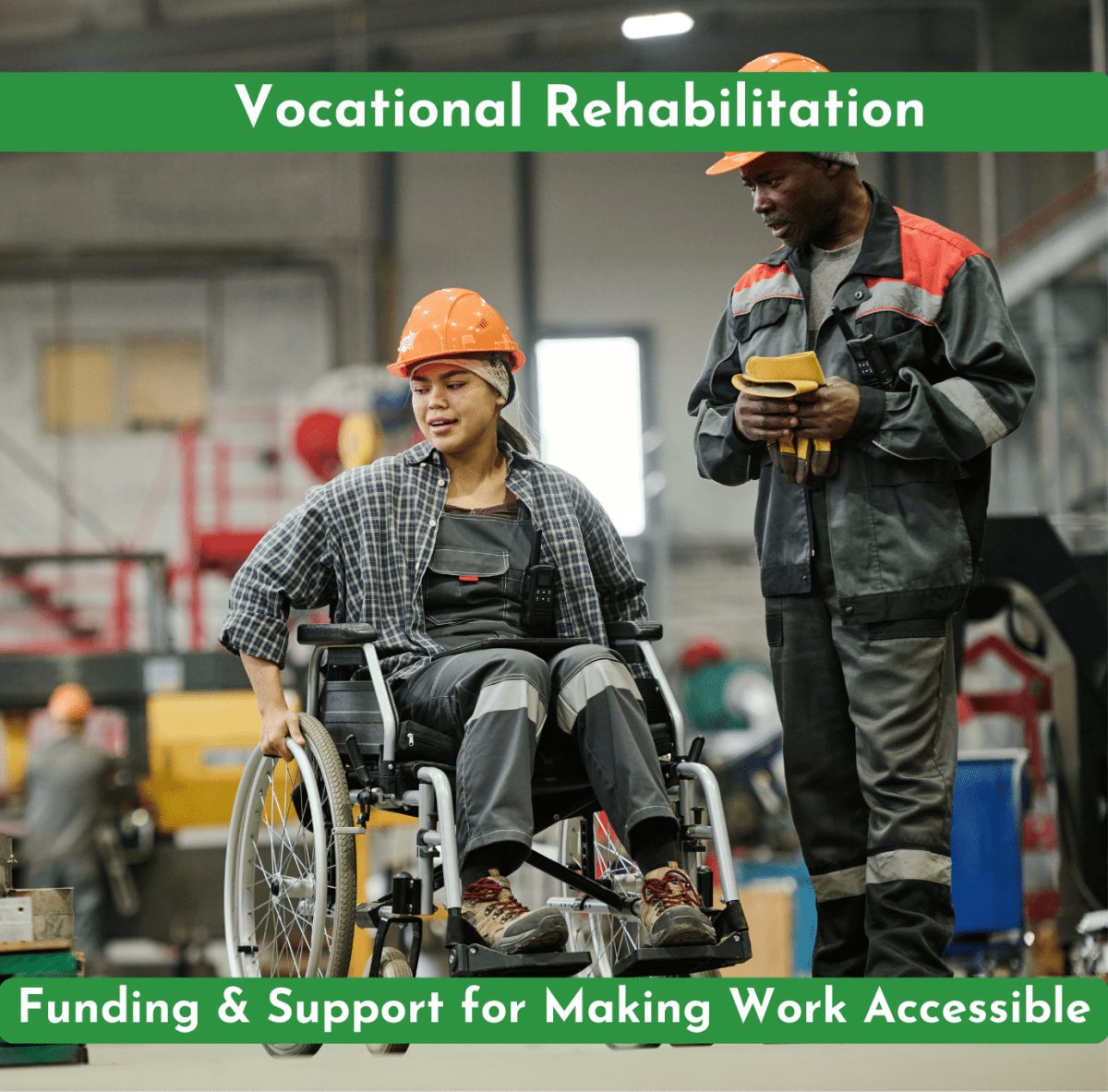
Vocational Rehabilitation | Funding & Support for Making Work Accessible
Vocational Rehabilitation | Funding & Support for Making Work Accessible
Vocational Rehabilitation (VR) is a state-supported program designed to help individuals with disabilities move into or stay in meaningful employment. If you have a health condition, injury, or disability that makes it harder to prepare for work, get a job, advance in your career, or return to work, VR is an option worth exploring. It helps with things like career exploration, training or education, assistive tools and technology, job site or home-to-work accommodations, job search and placement support, and job-retention services. If you’re thinking about work but aren’t sure where to start—or if you're already working and want extra supports—VR may open doors that otherwise feel closed.
- Alabama (334) 293-7500
- Alaska (907) 465-2814
-
Arizona (602) 542-6295
- American Samoa (684) 699-1371 or (684) 699-4234
- Arkansas-General (501) 296-1600
-
Arkansas-Blind (501) 682-5463
- California (916) 324-1313
- Colorado (303) 318-8571
- Connecticut-General (860) 424-4844
- Connecticut-Blind (860) 602-4008
- Delaware-General (302) 739-4748
- Delaware-Blind (302) 255-9800
- District of Columbia (202) 730-1700
- Florida-General (850) 245-3479
- Florida-Blind (850) 245-0300
- Georgia (866) 489-0001
- Guam (671) 475-4200
- Hawaii (808) 586-9729
- Idaho-General (208) 334-3390
- Idaho-Blind (208) 334-3220
- Illinois (800) 843-6154
- Indiana (800) 545-7763
- Iowa-General (515) 281-4211
- Iowa-Blind (515) 281-1333
- Kansas (785) 368 -7471
- Kentucky (502) 782-3402
- Louisiana (225) 219-2225
- Maine-General (207) 623-7943
- Maine-Blind (207) 623-7954
- Maryland (410) 554-9442
- Massachusetts-General (617) 204-3600
- Massachusetts-Blind (617) 626-7509
- Michigan-General (517) 582-3148
- Michigan-Blind (517) 373-2062
- Minnesota-General (651) 259-7367
- Minnesota-Blind (651) 642-0500
- Mississippi (800) 443-1000
- Missouri-General (573) 751-3251
- Missouri-Blind (573) 751-4249
- Montana (406) 444-4179
- Nebraska-General (402) 471-3644
- Nebraska-Blind (402) 471-2891
- Nevada North: (775) 684-4040 / South: (702) 486-5230
- New Hampshire (603) 271-3471
- New Jersey-General (609) 292-7318
- New Jersey-Blind (973) 648-3333
- New Mexico-General (505) 954-8500 or (505) 954-8562
- New Mexico-Blind (505) 827-4479
- New York-General (800) 222-5627
- New York-Blind (866) 871-3000
- North Carolina-General (800) 689-9090
- North Carolina-Blind (919) 527-6704
- North Dakota (701) 328-8950
- Northern Marianas (670) 322-6537
- Ohio (866) 895-0058
- Oklahoma (405) 951-3400
- Oregon-General (503) 945-5880
- Oregon-Blind (971) 673-1588
- Pennsylvania (717) 787-5476
- Puerto Rico (787) 729-0160
- Rhode Island (401) 421-7005
- South Carolina-General (800) 832-7526
- South Carolina-Blind (888) 335-5951 or (803) 898-8731
- South Dakota-General (605) 773-3195
- South Dakota-Blind (605) 773-4644
- Tennessee (615) 313-4891
- Texas (800) 628-5115
- Utah (801) 535-3881
- Vermont-General (802) 241-1455
- Vermont-Blind (800) 639-5861
- Virgin Islands (340) 774-0930 Ext. 4283
- Virginia-General (804) 662-7000
- Virginia-Blind (804) 371-3151
- Washington-General (360) 725-3610
- Washington-Blind (800) 552-7103
- West Virginia (304) 356-2060
- Wisconsin (608) 261-0050
- Wyoming (307) 777-8650
Why we know this works
Why we know this works
How to access this resource
How to access this resource
Frequently Asked Questions
Frequently Asked Questions
Solve the whole puzzle! Get more education, resources & services
-

Free Resources
Access free educational resources, guides, and materials from AskSAMIE to learn about...
-

Community Supports
Not every solution is a product. This collection points to community programs...


Dive Deeper: A knowledge base of solutions for real caregiving questions
View all-

21 Easy DIY Wheelchair Costumes for Adults
Looking for some fun and creative costume ideas that will make your wheelchair a key part of your Halloween outfit? This guide brings together 21 easy DIY wheelchair costumes for adults. From...
21 Easy DIY Wheelchair Costumes for Adults
Looking for some fun and creative costume ideas that will make your wheelchair a key part of your Halloween outfit? This guide brings together 21 easy DIY wheelchair costumes for adults. From...
-

Improve Sleep for Seniors: Aging-in-Place Tips ...
Better sleep for older adults starts with three changes: a supportive sleep position, safer nighttime lighting, and a consistent wind-down routine. Here's what occupational therapy practitioners recommend for aging in...
Improve Sleep for Seniors: Aging-in-Place Tips ...
Better sleep for older adults starts with three changes: a supportive sleep position, safer nighttime lighting, and a consistent wind-down routine. Here's what occupational therapy practitioners recommend for aging in...
-

Adaptive Cooking Equipment: What You Need for Y...
The right adaptive cooking equipment makes cooking safer and more independent for older adults and people with arthritis, tremors, stroke, or memory loss. See which kitchen tools occupational therapy practitioners...
Adaptive Cooking Equipment: What You Need for Y...
The right adaptive cooking equipment makes cooking safer and more independent for older adults and people with arthritis, tremors, stroke, or memory loss. See which kitchen tools occupational therapy practitioners...


