
Free Video Training: Effective Communication Strategies
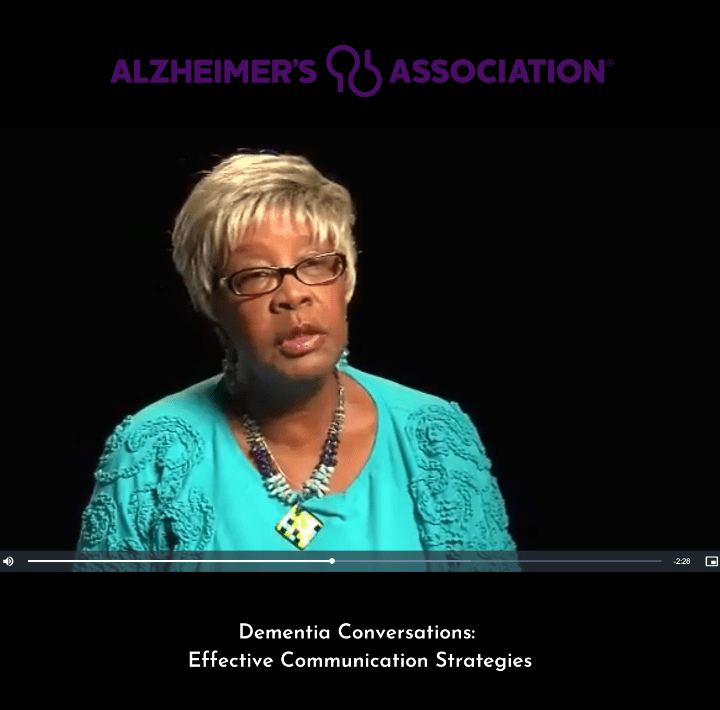
Communication is more than just talking and listening – it’s also about sending and receiving messages through attitude, tone of voice, facial expressions and body language. Learn how communication takes place when someone has Alzheimer’s, learn to decode the verbal and behavioral messages delivered by someone with dementia, and identify strategies to help you connect and communicate at each stage of the disease.
Click here to go to training and hit the purple button to add to cart at Alzheimer's Association Training Website. Then you'll be able to watch it for free!
Why we know this works
We love this course because as occupational therapy practitioners (OTPs) we watch loving caregivers get stuck in arguments over facts when the real message is in tone, face, and body language. How do you communicate with someone who has dementia? You stop correcting and start decoding, because communication is more than talking and listening, and this free Alzheimer's Association training teaches you to read the verbal and behavioral messages your loved one is sending and to connect at every stage of the disease. Follow the link, add it to your cart on their website, and watch it for free whenever you need a refresher.
It is especially important for family caregivers facing repeated questions, agitation, or a loved one who can no longer find the words. If bathing, mealtime, or transfer struggles are your bigger challenge, pair this with our Video Training: Essential Concepts to Care for Folks with Dementia.
How to access this resource
1. Click this link: https://training.alz.org/products/4036/effective-communication-strategies
2. At Alzheimer's Association website click purple button to Add To Cart
3. Follow the steps to get free access to the video training
Frequently Asked Questions
Q: Is this Alzheimer's communication training really free?
Yes, this video training from the Alzheimer's Association is completely free. Simply click the link to their training website, add the course to your cart (for $0.00), and you'll have immediate access to watch the full training program.
Q: What communication strategies will I learn for dementia patients?
You'll learn how to decode verbal and behavioral messages from someone with dementia, understand how communication changes at each stage of Alzheimer's disease, and discover practical strategies for connecting through attitude, tone of voice, facial expressions, and body language.
Q: How long is the effective communication strategies video training?
While the specific duration isn't listed, this comprehensive training covers essential communication techniques for all stages of dementia. You'll have unlimited access to watch and rewatch the content at your own pace once enrolled.
Q: Who should take this dementia communication course?
This training is ideal for family caregivers, professional caregivers, healthcare workers, and anyone who regularly interacts with people living with Alzheimer's disease or other forms of dementia.
Q: What makes communication difficult with Alzheimer's patients?
Communication becomes challenging because dementia affects how people process information, express thoughts, and understand others. This training teaches you to recognize these changes and adapt your communication style accordingly.
Q: Can I access this training on mobile devices?
Since this is hosted on the Alzheimer's Association's training platform, you should be able to access it on various devices. The training is designed to be accessible for caregivers who need flexible learning options.
Q: Will this training help with behavioral issues in dementia?
Yes, the course specifically covers how to decode behavioral messages from people with dementia, helping you understand what they're trying to communicate through their actions when words become difficult.
Share

Solve the whole puzzle! Get more education, resources & services
-
Caregiver Training Courses
Go to website for the full training library We've partnered with Higher...
-
Free Resources
Access free educational resources, guides, and materials from AskSAMIE to learn about...
-
Community Supports
Not every solution is a product. This collection points to community programs...
Dive Deeper: A knowledge base of solutions for real caregiving questions
View all-
Seniors Get Up Without Help: How to Prevent Fal...
Seniors often try to get up without help for practical reasons — not stubbornness. Here's how occupational therapists prevent falls with home setup, alarms, and empowering language that protects dignity....
Seniors Get Up Without Help: How to Prevent Fal...
Seniors often try to get up without help for practical reasons — not stubbornness. Here's how occupational therapists prevent falls with home setup, alarms, and empowering language that protects dignity....
-
Are Bed Rails Safe for Elderly? Risks & Options...
Bed rails can help prevent falls, but the wrong design can cause entrapment. Here's what the CPSC's 2023 ruling changed, how to use bed rails safely, and which OT-approved alternatives...
Are Bed Rails Safe for Elderly? Risks & Options...
Bed rails can help prevent falls, but the wrong design can cause entrapment. Here's what the CPSC's 2023 ruling changed, how to use bed rails safely, and which OT-approved alternatives...
-
Oral Hygiene Isn't Optional at Any Age
Oral hygiene affects everything from cavities to pneumonia to dementia risk, and it looks different at every age. Here is what a geriatric dentist and an OT want caregivers to...
Oral Hygiene Isn't Optional at Any Age
Oral hygiene affects everything from cavities to pneumonia to dementia risk, and it looks different at every age. Here is what a geriatric dentist and an OT want caregivers to...