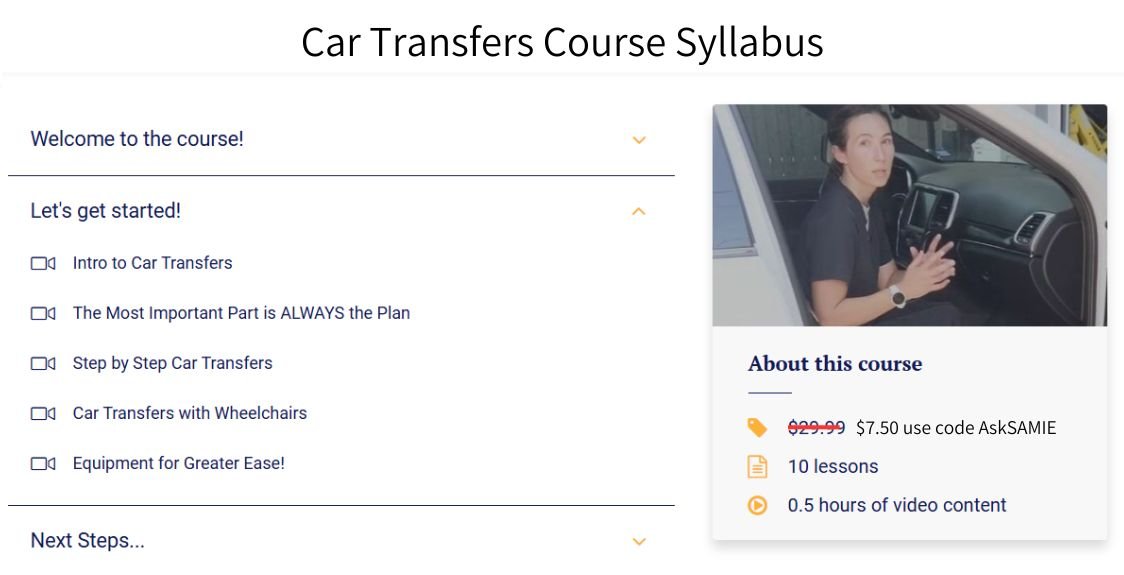
Video Training: Car transfers
Car transfers can be intimidating and confusing. Take this course to learn about the easiest, safest ways to plan for and perform transfers into and out of a car. Includes training with wheelchairs and walkers.
Higher Standards Caregiver Training has a catalog of over 30 specific and detailed training courses for family caregivers. With the ASKSAMIE coupon code you can get access to the entire catalog for 60 days for $19.99!
See the Advanced Family Caregiver Training University courses here!
Why we know this works
We love this course because as occupational therapy practitioners (OTPs) we know the car transfer is the one families avoid, and skipped car rides quickly turn into missed doctor visits and a shrinking world. How do you get someone from a wheelchair into a car? You plan it before you ever reach the door: this 30 minute video covers the easiest, safest ways to plan for and perform transfers into and out of a car, including training with both wheelchairs and walkers.
It is especially important for caregivers driving a loved one to appointments after a stroke, a hip or knee replacement, or with the leg weakness that makes the step into a car seat feel scary. If sliding across the seat is the sticking point, our Car Transfer Slide Sheet can help, and if your loved one cannot bear weight through their legs, take the Transferring Folks Who Can't Bear Weight course before attempting car transfers.
Specifications
Specifications
Duration: 30 mins.
Frequently Asked Questions
Q: How does the Video Training: Car transfers work? This comprehensive online training course teaches family caregivers the safest and easiest methods for helping individuals transfer into and out of vehicles. The course covers detailed techniques for transfers involving wheelchairs and walkers, providing step-by-step guidance that you can access anytime online.
Q: What specific transfer techniques are covered in the car transfer training? The course covers essential car transfer methods for both wheelchair users and individuals who use walkers. You'll learn proper body mechanics, positioning strategies, safety protocols, and equipment considerations to ensure safe transfers while preventing injury to both the caregiver and care recipient.
Q: How much does the Video Training: Car transfers cost with the ASKSAMIE discount? While the course normally costs $29.99, you can get it for just $6.25 using the coupon code ASKSAMIE, which provides a 75% discount. This makes professional caregiver training accessible and affordable for families.
Q: Who should take this car transfer training course? This training is ideal for family caregivers, professional caregivers, healthcare workers, and anyone who assists individuals with mobility challenges. Whether you're caring for an aging parent, spouse, or family member who uses mobility aids, this course provides essential safety knowledge.
Q: Can I access the entire Higher Standards Caregiver Training catalog? Yes! With the ASKSAMIE coupon code, you can get access to the complete catalog of over 30 specialized caregiver training courses for 60 days at just $19.99. This includes the Advanced Family Caregiver Training University courses covering various medical situations and equipment use.
Q: Is the car transfer training suitable for beginners? Absolutely. The course is designed to be accessible for caregivers at all experience levels, breaking down complex transfer techniques into easy-to-understand steps. No prior medical or caregiving experience is required to benefit from this training.
Q: How long do I have access to the Video Training: Car transfers course? Once purchased, you have ongoing access to the training materials, allowing you to review the techniques and safety protocols whenever needed. This ensures you can refresh your knowledge and maintain confidence in performing safe car transfers.
Q: What makes car transfers particularly challenging for caregivers? Car transfers involve unique challenges including confined spaces, awkward angles, varying vehicle heights, and the need to navigate around car doors and seats. This specialized training addresses these specific obstacles and provides practical solutions for common transfer scenarios.
Share

Solve the whole puzzle! Get more education, resources & services
-
Caregiver Training Courses
Go to website for the full training library We've partnered with Higher...
-
Free Resources
Access free educational resources, guides, and materials from AskSAMIE to learn about...
-
Community Supports
Not every solution is a product. This collection points to community programs...
Dive Deeper: A knowledge base of solutions for real caregiving questions
View all-
Seniors Get Up Without Help: How to Prevent Fal...
Seniors often try to get up without help for practical reasons — not stubbornness. Here's how occupational therapists prevent falls with home setup, alarms, and empowering language that protects dignity....
Seniors Get Up Without Help: How to Prevent Fal...
Seniors often try to get up without help for practical reasons — not stubbornness. Here's how occupational therapists prevent falls with home setup, alarms, and empowering language that protects dignity....
-
Are Bed Rails Safe for Elderly? Risks & Options...
Bed rails can help prevent falls, but the wrong design can cause entrapment. Here's what the CPSC's 2023 ruling changed, how to use bed rails safely, and which OT-approved alternatives...
Are Bed Rails Safe for Elderly? Risks & Options...
Bed rails can help prevent falls, but the wrong design can cause entrapment. Here's what the CPSC's 2023 ruling changed, how to use bed rails safely, and which OT-approved alternatives...
-
Oral Hygiene Isn't Optional at Any Age
Oral hygiene affects everything from cavities to pneumonia to dementia risk, and it looks different at every age. Here is what a geriatric dentist and an OT want caregivers to...
Oral Hygiene Isn't Optional at Any Age
Oral hygiene affects everything from cavities to pneumonia to dementia risk, and it looks different at every age. Here is what a geriatric dentist and an OT want caregivers to...